

The Lolly-Jar Diversion: Why Your Parents Are Using Your Children to Avoid Their Legacy Questions
It's a standard scene in lounge rooms across Australia. You’re visiting your parents, perhaps helping them clear out a cupboard, move something to the garage or showing them how to use a new app. They sneak some lollies to the grandkids, you ask them not to, they ignore you with the all knowing smile.
Read in this article
Have you avoided this conversation before?
Its the routine visit. The conversation drifts, as it inevitably does, toward the future. You mention the house, the superannuation, or perhaps a news story about a family torn apart by a messy estate fight in the court, or how a local tragedy was reporting in your social feed and a GoFundMe page was set up by friends seeking donations, to help the grief-stricken survivors.
You've had this conversation before, and it looks like you're going to get the same one again.
'I’ll do it when I’m older,' your father says, waving a hand as if dismissing a fly. 'I don’t need a Will yet. Your mother and I are fine. You kids know what to do if I get sick. There is plenty of time.'
It sounds reasonable. It sounds like patience. But in the world of neurofinance and behavioral estate planning, that sentence is a clinical red flag. It is the first sign of a condition we call Atestacy: the biological state of being alive without a valid structure for your legacy.
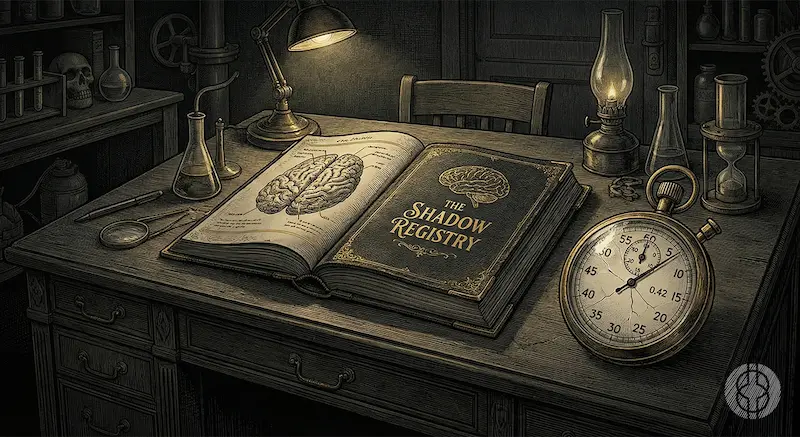
The 'I’m too young' excuse is not a logical conclusion. It is a 0.42-second glitch in your decision making neural hardware.
The Physics of the 0.42s Gap
To understand why your father says this, or why your best friend who you're in business with claims they're 'too busy' to sign a partnership agreement, or why you yourself have a bowel cancer screening kit sitting unopened in the bathroom cabinet, we have to look under the hood.
Your brain has evolved over thousands of years as a simulator designed for the savannah, not the suburbs. It has two primary speeds and decision systems running side by side like trains racing each other on a train line.
- First, there is the Red Line. This is your brain's Amygdala. It is the internal security alarm that has kept our species alive for millennia. It reacts in 0.08 seconds. When it senses a 'predator' - which, in modern times, is any complex, high-stakes decision involving death or money - it triggers a freeze response. It wants to save metabolic energy. It wants you to stay in the cave where it is safe.
- Second, there is the brain's Green Line. This is your Prefrontal Cortex, or what I call the Sober Friend. This part of the brain handles logic, legacy, and long-term planning. But the Sober Friend is slow. It takes 0.50 seconds to arrive at the brain's decision station.
This leaves a 0.42-second gap where your fear is driving the car before your logic has even found the keys. In that tiny window, your brain invents a 'smart' excuse to avoid the discomfort. 'I’ll do it when I’m older' is simply the script your brain's Amygdala writes to stop the 'Sober Friend' from spending glucose on having to carefully think through a difficult conversation.
Have You Heard the Script Before?
Take a moment to reflect upon the recent conversations in your social orbit.
Have you heard your parents say this? They treat the Will as a 'Death Document' rather than a 'Delivery System for Love.' By avoiding the paperwork, they feel they are avoiding the event. But the science of Compensatory Control tells us that the opposite is true. The more they avoid the structure, the more anxiety they actually feel. They are using procrastination to soothe a fear they cannot name.
Have you heard your friends say this? You see them building businesses, buying investment properties, even settling up an SMSF to invest their super their way) and meticulously managing their fitness. Yet, when you ask about their Power of Attorney, they laugh it off. 'We’re too young for that adultling stuff,' they say. They are suffering from a Trojan Cocktail of biases: a mix of overconfidence and the 'Simplicity Trap.' They believe that because they are healthy today, the 'Frozen Ship' of incapacity could never happen to them.
But the most important question is this: Have you said it yourself?
Have you found yourself distracted by 'urgent' emails or the need to mow the lawn whenever the thought of your own legacy planning for you and your kids arises? This is the Wonky Wheel of human behavior. Like a shopping trolley that constantly veers toward the easy path of the ditch, your brain naturally drifts away from the effort and 'Metabolic Expense' of planning and the thinking and conversations that naturally goes with that.
You aren't lazy. You are just biologically stuck in the 0.08-second loop.
The Cost of Scar Tissue
As anyone who’s had a knee reconstruction or hip replacement surgery will tell you, in medical rehabilitation, there’s a hard truth: if you don't move the joint within twenty-four hours of surgery, scar tissue sets in. The limb loses its range of motion. The healing is delayed, or worse, defeated entirely. It's move it or lose it - no matter how you feel about it.
Behavioral change works the same way. If you wait until you 'feel like' having the great conversation, you are waiting for a feeling that is never coming. Your brain is not designed to feel 'good' about discussing your own demise.
If you wait until you are 'older,' you aren't just delaying a task. You are allowing Emotional Scar Tissue to build up in your family. You are training your children to believe that transparency is dangerous. You are teaching your business partners that 'She'll be right' is a valid risk-management strategy.
When the crisis finally arrives - and in Australia, where the Postcode Lottery of intestacy laws is cold and rigid, it always arrives - the lack of a structure becomes a predator. It tears through families, turns siblings into litigants, and erases the wealth you spent forty years building.
Delaying the important conversations of life doesn't make it easier. It only makes the eventual crash more violent.
The LeBron Shunt: Reporting for Rehab
So, how do we fix a biological glitch? We don't do it with willpower. We do it with a Clinical Shunt.
In her research on human values, neuroscientist Emily Falk points out that we can lower our defensiveness by refocusing on what we value most. In his book Shift, Ethan Kross shows that we can bypass our brains emotional 'Internal Toddler' by using Distanced Self-Talk. At Sapience, we call this the LeBron Shunt.
When you feel the 'Red Line' rising - when you feel that urge to say 'I'll do it later' - I want you to stop.
Lets try the third person distancing self-talk technique. Speak your own name out loud.
'[Name], you don't need to feel ready. You just need to report for rehab. Pick up the pen. Open the folder. Follow the protocol.'
This tiny linguistic shift moves the decision from your panicked Amygdala brain region to your brains strategic Prefrontal Cortex. It turns a 'Moral Failure' into a 'Mechanical Task' moving a decision out of the emotional weeds to navigate and into a simple checklist to follow.
The Hero’s Journey
Love is not just a feeling. Love is a delivery system. If you love your family, you don't leave them a 'Perfect Problem' - a brilliant but unsigned draft, a plan that could have been but wasn't. You leave them an Imperfect Solution. You build the architecture today so they don't have to fight the storm tomorrow.
Whether your family survives the storm depends entirely on whether you had the courage to ignore your Savannah Brain and start the load-bearing today.
Don't wait to be 'older.' Your legacy doesn't care how old you are. It only cares if you are ready.
Micro Steps: Three questions to start (not finish) a conversation
Most people lose their legacy because they focus on the house and ignore the 'Shadow Estate.' So when you're starting the conversation, just see if you can list the following three items. (Do not find the policy numbers. Just name the providers).
- Superannuation: Who holds your retirement savings?
- Life Insurance: Is it inside or outside your super?
- The Digital Lock: Where do you keep your primary passwords?
Then, the next time the conversation occurs, just 'List the people who can restart the engine if the ship freezes'.
- The Financial Guard: Who is the one person you trust to handle the bank accounts if you cannot?
- The Moral Guard: Who would you want to raise your children or speak for your health if you were offline?
Science proves that small actions beats big feeling every time.
When you're facing the pushback of the Australian addadgae of 'she'll be right', try what we call a 'soft start' approach to life's big questions - rather than hope to achieve the impossible in an afternoon, start the process; asks the initial questions and let our brains need to complete open loops and answer unfinished puzzles work in your favour; softley start to move you in the right direction
When you're ready to piece it all together, we’re here to help with the next step in that conversation.
Call us today on 1300 137 403 or email us here for a no-obligation private chat about your situation.
 Drew Browne is a specialty Financial Risk Advisor working with Small Business Owners & their Families, Dual Income Professional Couples, and diverse families. He's an award-winning writer, speaker, financial adviser and business strategy mentor. His business Sapience Financial Group is committed to using business solutions for good in the community. In 2015 he was certified as a B Corp., and in 2017 was recognised in the inaugural Australian National Businesses of Tomorrow Awards. Today he advises Small Business Owners and their families, on how to protect themselves, from their businesses. He writes for successful Small Business Owners and Industry publications. You can read his Modern Small Business Leadership Blog here. You can connect with him on LinkedIn. Any information provided is general advice only and we have not considered your personal circumstances. Before making any decision on the basis of this advice you should consider if the advice is appropriate for you based on your particular circumstance.


