
The ultimate conversation stopper for most parents at the weekend BBQ with friends is, 'How will you pay for school fees?'
Asking this question usually results in all surrounding conversation falling silent, as everyone has an opinion on this uncomfortable and expensive topic.
Braces, Orthodontics, and School Fees – the big three conversation stoppers for every parent (and engaged Uncle or Aunty).
No matter if you're hoping to send your child to an elite private school, a selective school or the local government school, you know you're going to need to dip deep into your pocket.
If you're planning for a child's education likely to span 13 years from kindergarten to Year 12, the sooner you begin planning for this expense, the better your likely outcomes will be. Life-long learning costs for us adults are also a growing issue for many knowledge workers and professionals who will also need to regularly upskill and reskill throughout their careers.
Below we'll look at different ways to tackle this seemingly insurmountable financial challenge of modern life, and continuing education.
Read in this article
- Funding your children's education - How deep will you have to reach into your pocket?
- Education is extended into Adulthood
- What you may need to save, Weekly, Monthly, or Annually to achieve your education goals
- Education is a long-term investment - so Get Practical
- 1. Use a high-interest Savings Account
- 2. Saving in an Offset Account attached to your Home Loan
- 3. Savings in a Saving (Investment Bond)
- Education - the bill that keeps on growing
- FAQ's
- You mentioned public school fees. I thought government schools were free?
- Is a high-interest savings account a bad idea for school fees?
- Why do you talk about an offset account over a regular savings account?
- What exactly is a Savings Bond and why the 10-year rule?
- This all seems overwhelming. Where should I even begin?
- Sources & Further Reading
Funding your children's education - How deep will you have to reach into your pocket?
Fact of Life #1 — Getting the education we want for our children is going to cost money - and for the majority of us, sacrifice and some sort of a long-term saving plan.
- Like many things in life, it helps to set goals and plan for them, but what if you could automate the process and break it down into weekly, monthly, and yearly saving goals?
Education is extended into Adulthood
Fact of Life #2 — Today's modern education-driven employment market means there is an ever-growing competition for and need for lifelong learning and education.
As technological, social, and economic changes continue to accelerate, there is a continual need for ongoing development and upskilling just to remain competitive and for future-proofing careers.
{modal width="1000" url="https://sapience.com.au/images/blog-assets/planning-for-future-school-fees-chart-sapience-financial.png"}Click for full view{/modal}
What you may need to save, Weekly, Monthly, or Annually to achieve your education goals
Have a plan for your money and know the numbers you need to work with, weekly, monthly, and annually.
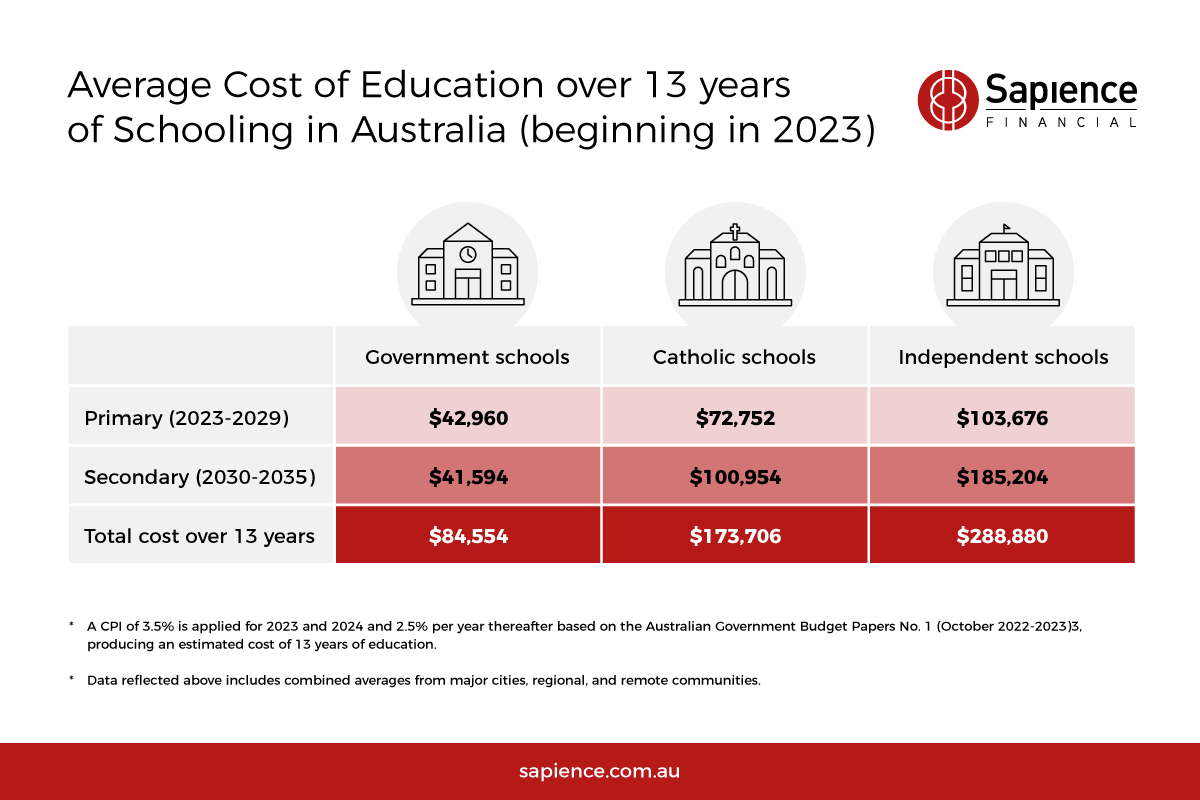
2023 Education Costs — Kindergarten to Y12
The following table averages both city and regional costs for education for 2023.
| $AU School Fees | Government School | | Catholic School | | Independent School |
|---|---|---|---|
| Estimated average total cost for (K to Year 12) 13 years | $84,554 | $173,706 | $288,880 |
| Start saving when a child is born | 18 years | 18 years | 18 years |
| Save Yearly | $4,697 | $7,802 | $18,938 |
| Save Monthly | $391 | $804 | $1,3378 |
| Save Weekly | $90 | $185 | $307 |
| Start saving when the child starts school | 13 years | 13 years | 13 years |
| Save Yearly | $6,504 | $10,803 | $22,221 |
| Save Monthly | $535 | $1,113 | $1,851 |
| Save Weekly | $124 | $256 | $426 |
Education is a long-term investment - so Get Practical
If you're planning to save for an important long-term project, like education fees, be pragmatic about how you manage money and get to know your own money behaviors.
Here are three options many people use to save for a children's education
1. Use a high-interest Savings Account
The traditional savings account is a good start to any longer-term plan. The downside is you will pay tax on the earnings of your savings, at your marginal tax rate
If you open a savings account in your child's name, they will pay tax at the highest marginal rates when earnings exceed $1,307. Special rules apply and you pay tax on certain income types at a higher rate on income you receive if you're under 18 years old.
2023 Tax rates for Australian Residents who are under age 18 for 2022–23
Special rules apply and you pay tax on certain income types at a higher rate on income you receive if you're under 18 years old. This rule was introduced to discourage adults from diverting income to their children.
| Income | Tax rates for 2022–23 income year |
|---|---|
| $0 – $416 | Nil |
| $417 – $1,307 | Nil plus 66% of the excess over $416 |
| Over $1,307 | 45% of the total amount of the not excepted income |
Source: ATO
2. Saving in an Offset Account attached to your Home Loan
A simple, but potentially very effective way of saving for education costs is through your home loan's offset account.
An offset account allows you to make extra repayments into a bank account attached to your home loan. These extra savings are liquid and help reduce the daily interest rate calculated on your home loan too. For example, if you have a home loan of $500,000 with $100,000 in an offset account, the bank calculates interest based on only $400,000. When the time comes due to pay education costs, you can redraw those additional funds you saved over the years, on demand.
- The money you have in an offset account is generating an after-tax return equal to the interest rate of your home loan. For instance, if your bank is charging you 6.00% interest on your loan, the funds in your offset account save you this rate of interest being charged.
Pro Tip: Compared with a standard savings account, the value of an offset account is usually greater than the interest in a savings account (that you will also need to pay tax on).
- The key to this strategy is discipline and the ability to resist temptation, for the next 13 years.
3. Savings in a Saving (Investment Bond)
An alternative and equally effective way of saving for education costs is through a Savings Bond (also referred to as an Investment Bond). They provide a variety of investment options such as shares, property and fixed interest, that are not normally available to minors.
Pro Tip: Investment bonds are also referred to as 'tax paid investment bonds' because any earnings get taxed at the company tax rate (currently 25%) within the investment. As long as money remains invested for 10 years, the investment provider pays the tax on the investment earnings so you don’t have to report the earnings in your tax return.
Pro Tip: For people in high-risk occupations, tradies or self-employed business owners with heightened bankruptcy risks, a Savings Bond (aka Investment Bond) may provide a savings environment that's shielded from bankruptcy creditors, so speak with your financial advisor and accountant about your specific needs.
- The key to this strategy is discipline and the ability to resist temptation, for the next 13 years.
Education - the bill that keeps on growing
Stay connected to good advice for the long haul. Many financial strategies, like saving for the long-term costs of children's education and an adult's continuing professional education, benefit from a long-term relationship with a financial advisor who you relate to and who understands what you want to achieve.
FAQ's
Your Future School Fee Preparation Questions, Answered. Here’s a quick summary of what you need to know about How will you pay for school fees?
You mentioned public school fees. I thought government schools were free?
That's a common misconception. While government schools don't have the hefty tuition fees of their private counterparts, the associated costs are far from zero. You still need to account for voluntary contributions, uniforms, textbooks, excursions, technology levies, and extracurricular activities. These "hidden" costs can add up to thousands of dollars per year, per child, and they definitely require a financial plan.
Is a high-interest savings account a bad idea for school fees?
It's not a bad idea, but it's often not the most efficient one. The main drawback is tax. Any interest you earn is taxed at your marginal rate, which can take a big bite out of your returns, especially if you're a high-income earner. If the account is in your child’s name, penalty tax rates can apply to earnings above a certain small threshold. So, while it's a simple strategy, it's crucial to understand how tax can slow your progress.
Why do you talk about an offset account over a regular savings account?
Many folks find the main advantage of using an offset account linked to your home loan is the tax-effective return. Instead of earning interest that gets taxed, the money in your offset account reduces the amount of interest you pay on your mortgage. The "return" you get is equal to your home loan interest rate, and because it's a saving rather than an earning, it's completely tax-free. It’s a powerful way to make your money work harder for you.
What exactly is a Savings Bond and why the 10-year rule?
A Savings Bond, or Investment Bond, is a type of managed fund where the tax on investment earnings is paid by the fund manager at a set rate (currently 30%). The "10-year rule" is the key benefit: if you hold the investment for at least 10 years and follow the contribution rules, you can withdraw the proceeds completely tax-free. This makes it a very attractive, long-term strategy for higher-income earners who would otherwise pay tax at a much higher rate.
This all seems overwhelming. Where should I even begin?
We understand completely; planning for costs 10 or 15 years down the track can feel daunting. The most important step is simply to start now. Begin by working out a rough estimate of the future costs for the type of education you envision for your children. From there, you can determine how much you need to save each month. Don't get paralyzed by the details—the best plan is one that you can start today and stick to consistently. And of course, seeking professional advice can help you create a tailored strategy that fits your specific circumstances.
Sources & Further Reading
- Moneysmart - Saving for your children's education
Run by the Australian Securities and Investments Commission (ASIC), this guide provides an excellent starting point for parents, covering the types of costs to expect and different savings strategies, reinforcing the need for early planning.
- Australian Taxation Office (ATO) - Tax rates if you're under 18 years old
This official government page details the special tax rules that apply to the investment income of minors. It clearly explains the low tax-free threshold and the high tax rates that apply above it, validating the article's points on the tax-inefficiency of standard savings accounts.
- Moneysmart - Offset account
A detailed explanation from ASIC on how offset accounts work. It explains the benefits of reducing the interest paid on a home loan and how this can be a more tax-effective strategy than earning interest in a separate savings account.
- ASIC - Investment bonds
This information page from the corporate regulator explains how investment bonds work, including the '10-year rule' for tax-paid withdrawals. It provides an authoritative source on how these products can be used for long-term savings goals like education.
- Productivity Commission - Report on Government Services (School Education)
While dense, this annual government report provides detailed data on government expenditure for schooling. It gives context to the real costs involved in the education system, supporting the article's premise that all forms of education have a significant cost.
Call us today on 1300 137 403 or email us here for a no-obligation private chat about your situation.
 Drew Browne is a specialty Financial Risk Advisor working with Small Business Owners & their Families, Dual Income Professional Couples, and diverse families. He's an award-winning writer, speaker, financial adviser and business strategy mentor. His business Sapience Financial Group is committed to using business solutions for good in the community. In 2015 he was certified as a B Corp., and in 2017 was recognised in the inaugural Australian National Businesses of Tomorrow Awards. Today he advises Small Business Owners and their families, on how to protect themselves, from their businesses. He writes for successful Small Business Owners and Industry publications. You can read his Modern Small Business Leadership Blog here. You can connect with him on LinkedIn. Any information provided is general advice only and we have not considered your personal circumstances. Before making any decision on the basis of this advice you should consider if the advice is appropriate for you based on your particular circumstance.